
The Best Line for Method Feeder Fishing in 2026
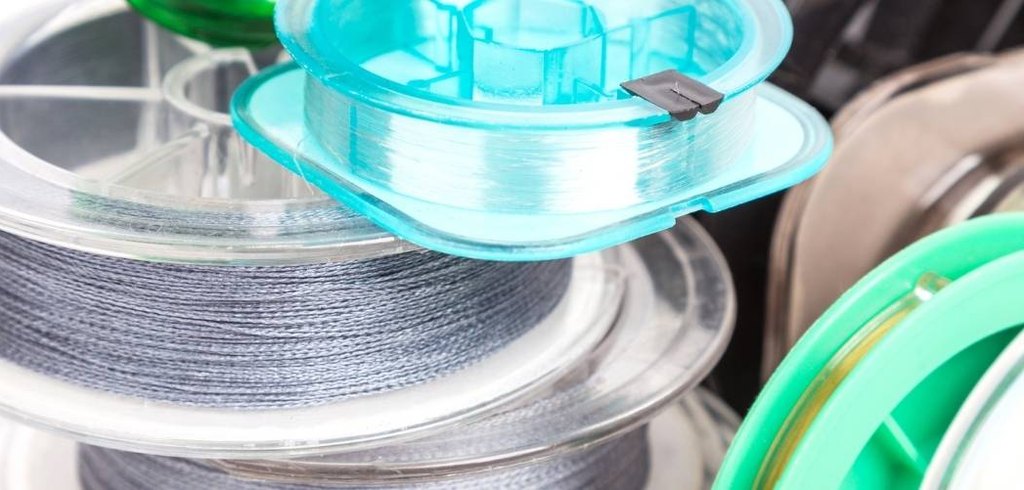
The method feeder tactic usually involves casting heavily loaded feeders often. To be consistent and effective with this tactic, it’s important to use a line that can withstand this sort of punishment.
The best line for method feeder fishing is one that can consistently stand up to the high demand the tactic uses.
This article details everything you will need to know in order to choose the best line for method feeder fishing depending on your specific circumstances.
We highlight different monofilament, braids, and fluorocarbon lines and suggest some great options that have been tried and tested.
Quick Answer
The Daiwa Tournament SLR Mono is my top overall pick because its Ultra Water Repellent finish gives clean, long casting and a non-absorbing line that stays consistent through a session.
For the least money my starting point would be the Preston Reflo Power Mono. The table below groups the lines by budget, from a premium casting mono to a cheap, supple all-rounder.
| Rank | Best for | Line | Best suited to |
|---|---|---|---|
| Premium (£10+) | |||
| #1 | Best Overall | Daiwa Tournament SLR Mono | Anglers chasing the cleanest-casting, non-absorbing feeder mono for range work. |
| #2 | Top for Big Fish | Berkley Big Game | Specimen anglers wanting record-proven strength near snags off a short link. |
| Mid-range (£8-£10) | |||
| #3 | Top Method Line | Drennan Feeder & Method Mono | Dedicated feeder anglers wanting a slick, purpose-coated mono that sinks and casts. |
| #4 | Great All-Rounder | Drennan Specialist XT Mono | Specimen feeder anglers needing an abrasion-resistant sinking mainline for snaggy venues. |
| #5 | Great for Commercials | Drennan Carp Feeder Mono | Commercial carp anglers wanting a fast-sinking mono that stays pinned down. |
| Budget (under £8) | |||
| #6 | Top Sinking Line | Daiwa N-Zon Sinking Feeder Mono | Anglers wanting a supple, low-glare sinking mono that fills two reels. |
| #7 | Best Budget | Preston Reflo Power Mono | Anglers after a proven, supple mono in fine diameters for hooklengths and pole rigs. |
What Are The Different Lines To Use When Method Feeder Fishing?
There are 3 different types of line you can use when method feeder fishing.
These are:
- Monofilament
- Braid
- Fluorocarbon
Monofilament
Monofilament is often abbreviated to ‘mono’ and is the most common line type to be used in fishing.
Mono fishing line is made from a single fibre of plastic. It comes in a wide range of diameters and breaking strains to suit the style of fishing you are practising.
Mono can be used as a mainline or as a hook length when method feeder fishing but it is important to ensure you use a mono that has a breaking strain high enough to deal with the exertion put on it by this tactic. More detail on this can be found later in this article.
Braid
Braid is constructed from multiple fibres of material and has a softer feel than mono.
The way braid is constructed means that it has a lot less stretch than monofilament.
Less stretch, generally means you can cast further and also means that the bites you get when using braid are a lot more ferocious and obvious on your feeder rod or bite indicators.
Fluorocarbon
Fluorocarbon fishing line is made of the fluoropolymer PVDF. It is well-known for its light-refracting properties and is a lot less visible in water than mono or braid.
For this reason, some anglers prefer fluorocarbon as a fishing line. It is fairly stiff with little stretch giving excellent feel and feedback. It is also a very dense material, which means it sinks quicker and you can get more strength for less diameter.
Anglers fishing waters where fish are known to be very wary and hard to catch, quite often believe that the best line for method feeder fishing on hard waters is fluorocarbon because of these properties.

What Is The Best Hook Length Material When Method Feeder Fishing?
One of the key parts of method feeder fishing is using a short hook link.
Quite often anglers will bury their hook link and bait within the method feeder ready for fish to bump and release the morsels which include the bait.
For this reason, many anglers fishing this method prefer a ‘stiffer’ hook link material so the bait almost springs out when the feeder is bumped.
Stiffer hook links also have good anti-eject properties and for this reason, a decent mono or a fluorocarbon are the preferred materials.
Having said this, there are cases where braid can work really well as a hook length. The subtlety of braided material can work really well if the fish just aren’t feeding as confidently as you would like.
How To Choose The Best Line For Method Feeder Fishing
To choose the best line for method feeder fishing, you first need to have an idea of what water you are going to be fishing and what fish you are fishing for.
The following factors should be considered before picking your method feeder fishing line:
- Size of fish you are likely to be catching
- The distance you are needing to cast
- Are you fishing in open water or near snags?
- The watercolour
- The brightness of the conditions
- The rig and feeder type you are going to be using
Size Of Fish
The size of the fishing you are trying to catch will affect your decision on the best line for method feeder fishing.
The larger the fish, the harder they pull back. So if you are fishing for carp, for example, you will need a line that has a higher breaking strain than if you are fishing for silverfish.
Casting Distance
If you are needing to cast far on your chosen water then the correct line choice is paramount. Braid is quite often considered the best line for method feeder fishing at distance.
This is because it has less stretch than mono and fluorocarbon meaning less energy is expelled into the line and more into the forward momentum of the cast.
Open water or snags
If you are fishing near snags when method feeder fishing then it is best to choose a line with a higher breaking strain with anti-abrasion properties.
For this reason, many anglers use braid when fishing near snags. It has less give when you first strike meaning there is a yard or two gained whereby a fish could otherwise have found the snag.
In open water, this isn’t a problem and any method feeder fishing line can be used.
Water Colour
The watercolour affects your choice of line in a couple of ways. Firstly it could dictate what colour line you use.
If the water is muddy and silty then a darker colour line should be chosen. If the water is weedy then maybe a green line would be the best option.
If the water is clear, we recommend using fluorocarbon as the best line for method feeder fishing. This is because the light refracting properties of this line will give you an edge in clear water.

The Brightness Of The Conditions
Similar to the colour of the water, the brightness can affect the best line for method feeder fishing because brighter conditions may make your line more visible to fish.
This is even more apparent if fishing in shallower water.
If you find yourself in these conditions then a clear monofilament line or fluorocarbon should be used.
The Rig & Feeder Type You Are Using
In modern-day angling, there are all sorts of fancy rigs and feeders on the market for fishermen to choose from.
If you are carp fishing, your hook bait and your fishing method are important decisions to make as they can be the difference between catching or not. If this subject interests you, we have a separate article on both carp fishing rigs and the best hook bait for carp fishing.
When method feeder fishing, the actual feeder you use can dictate what hook length line you use.
For example, using a method feeder mould would suit a small hook length and a small hook bait. With this fishing method anglers generally go down the mono or fluoro route when choosing the best line for method feeder fishing.
What Is The Best Strength Line To Use When Method feeder Fishing?
When method feeder fishing, the best breaking strain line to use will depend on the following factors.
- What size fishing you are targeting
- The distance you are casting
- The weight you are casting
- Whether or not you are fishing in or near weed, or snags
Check out this handy table that summarises the best breaking strain line to use for method feeder fishing, depending on these circumstances:
Fishing For Small To Medium Fish
| Casting Weight | Min Breaking Strain Line With No Snags or Weed | Min Breaking Strain Line With Snags or Weed |
|---|---|---|
| 0 - 1.5oz | 4lb | 6lb |
| 1.5 - 2.5oz | 5lb | 8lb |
| 2.5 - 4oz | 6lb | 10lb |
| 4oz+ | 8lb | 12lb |
Fishing For Medium To Specimen Sized Fish
| Casting Weight | Breaking Strain Line With No Snags or Weed | Breaking Strain Line With Snags or Weed |
|---|---|---|
| 0 - 1.5oz | 6lb | 10lb |
| 1.5 - 2.5oz | 8lb | 12lb |
| 2.5 - 4oz | 10lb | 12lb |
| 4oz+ | 12lb | 15lb |
How To Load Line Onto Your Reel When Method Feeder Fishing
So, you can have the absolute best line for method feeder fishing, but if you don’t load it properly onto your feeder reel then it just won’t perform at its best.
For your line to perform well on the cast and the retrieve, as well as to avoid unnecessary knots and tangles, the way you load the line onto your reel is very important.
Here is a short video explaining how to load your line onto your reel properly:
The Best Line For Method Feeder Fishing Reviewed
Daiwa Tournament SLR Mono
#1 Best Overall

Fine-quality monofilament doesn't come much better than the Daiwa Tournament SLR, which is why it sits at the top of my list. It casts beautifully and comes on a 300m spool.
The standout is the UWR, or Ultra Water Repellent, finish. It gives super-clean line travel through the rings, so a feeder goes out that bit further and smoother than it would on an ordinary mono.
That non-absorbing property is the clever bit. Because it doesn't let much water back to the spool, the line keeps its intended form and stays largely unaffected once wet, so it behaves consistently through a session rather than going limp and springy.
For anyone who wants the last word in a feeder mono and casts at range, the SLR's clean travel and steady consistency mean it's the best line I'd point to. It's the dearest option here, and more than a casual angler needs, but the quality earns its place.
Best suited to
Anglers chasing the cleanest-casting, non-absorbing feeder mono for range work.
Pros
- UWR finish for clean, long casting
- Non-absorbing, stays consistent when wet
- Exceptionally fine quality
Cons
- The most expensive line here
- More than casual anglers need
Berkley Big Game
#2 Top for Big Fish
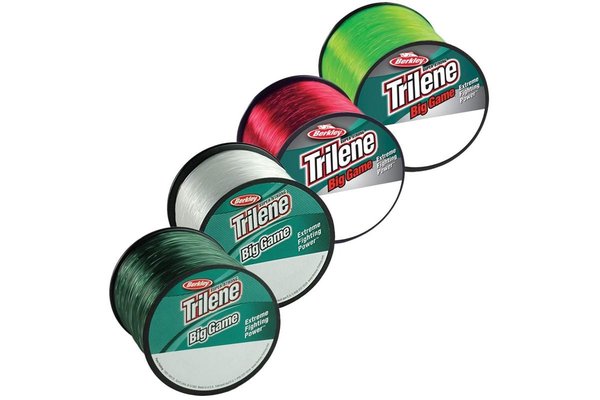
Records have fallen to the Berkley Big Game across carp, pike, bass and barbel, and that track record is exactly why it's my pick when big fish are on the cards.
It's built for power: extra tough, abrasion resistant, with the sort of extreme fighting strength a method-feeder angler wants when a good carp bolts for a snag off a short, strong link.
The properties are well judged for the job. Shock resistance with controlled stretch cushions a lunge, knot strength is outstanding, and holding power is great, so it inspires real confidence and control.
There's versatility too. It doubles as a shockleader for extreme casting or as a hooklength material, and it comes in four colours including this low-key green. As an all-round big-fish line, it's brilliantly strong.
Best suited to
Specimen anglers wanting record-proven strength near snags off a short link.
Pros
- Extreme strength and abrasion resistance
- Controlled stretch cushions lunges
- Great knot strength, four colours
Cons
- Thicker than a fine match mono
- Overkill for small silvers
Drennan Feeder & Method Mono
#3 Top Method Line

Made specifically for this style of fishing, the Drennan Feeder & Method Mono is the one I'd hand a dedicated feeder angler. It comes on a 250m spool.
Its secret is a special coating that gives a slick surface finish, and that coating brings a set of properties suited to feeder work rather than general fishing.
In practice it casts a long way and cuts under the surface easily, so it sinks and pins down out of the wind and tow. That keeps the rig stable and bites registering cleanly on the tip.
For an angler who fishes the method and pellet feeder regularly and wants a line engineered for the job, it's an excellent choice that doesn't cost the earth.
Best suited to
Dedicated feeder anglers wanting a slick, purpose-coated mono that sinks and casts.
Pros
- Slick coating for distance casting
- Cuts under the surface and sinks
- Made specifically for feeder work
Cons
- 250m spool, less than some
- Coating wears over heavy use
Drennan Specialist XT Mono
#4 Great All-Rounder
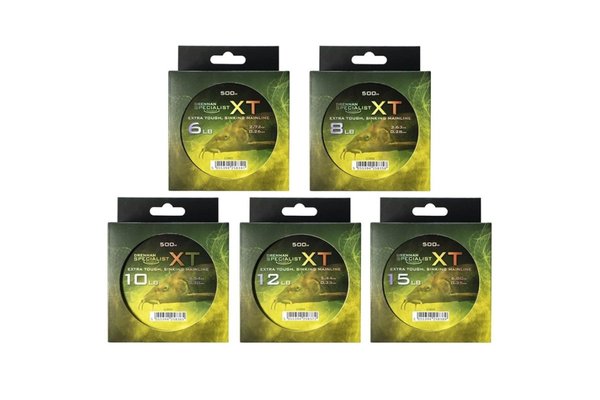
Toughness is the whole pitch of the Drennan Specialist XT, a sinking mainline built for maximum confidence when big fish and demanding conditions are on the menu. It arrives on a generous 500m spool.
Durability and reliability lead the way. It's highly abrasion resistant and stands up to challenging venues, so it takes the punishment of gravel bars and snaggy swims without letting me down.
Excellent knot strength backs that up, giving consistent performance where strength really matters, which is the entire point of a big-fish feeder line.
That big 500m spool loads two reels or gives plenty of re-spools, so it works out as strong value. As a rugged, dependable sinking mainline for specimen feeder work, it's a proper all-rounder.
Best suited to
Specimen feeder anglers needing an abrasion-resistant sinking mainline for snaggy venues.
Pros
- Tough and highly abrasion resistant
- Sinks and stays put
- Big 500m spool, great value
Cons
- Less refined than premium monos
- Heavier line for finesse work
Drennan Carp Feeder Mono
#5 Great for Commercials
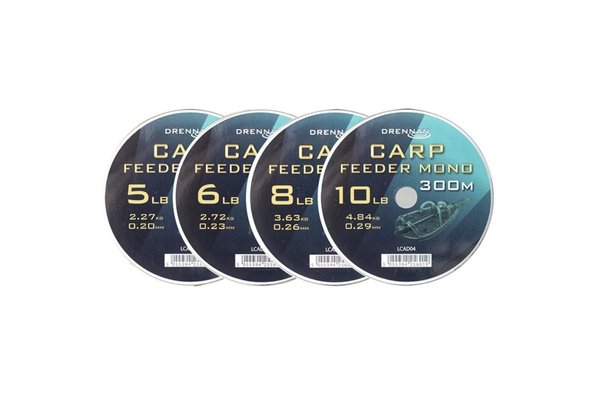
Commercial carp fisheries are a hectic, punishing test, and the Drennan Carp Feeder Mono is designed squarely for them. It comes on a 300m spool.
It's exceptionally strong and abrasion resistant, which is what a busy commercial demands when the fish run big and the action off a method feeder is relentless.
The fast-sinking property is the standout. It settles quickly and stays tight to the lakebed, keeping the rig pinned and bite indication crisp on the tip rather than letting the line bow in the tow.
For an angler fishing method and pellet feeders on commercials for a good stamp of carp, it's a purpose-made line that does the job without a fuss.
Best suited to
Commercial carp anglers wanting a fast-sinking mono that stays pinned down.
Pros
- Strong and abrasion resistant
- Fast-sinking, stays tight to the bed
- Made for commercial carp
Cons
- Commercial-carp focused
- Not the finest for shy bites
Daiwa N-Zon Sinking Feeder Mono
#6 Top Sinking Line
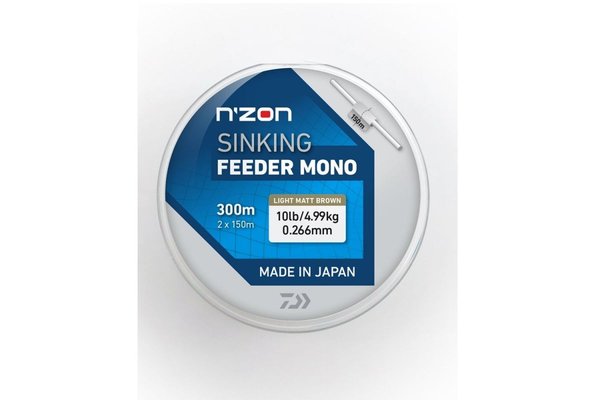
Where a nylon mainline beats braid for feeder work, the Daiwa N-Zon sinking edition is the one I reach for, and it's superb value into the bargain.
It's a purpose-made sinking monofil for feeder fishing, so it pins down out of the tow and wind. It's also highly supple yet abrasion resistant and durable, a good balance between casting and taking knocks.
Superior knot strength and a low-glare colour for reduced visibility round out a line built for the job, and it handles nicely off the spool.
It's supplied on 300m spools with a 150m marker, so it easily fills two reels, and it's made in Japan. As a well-made sinking feeder mono, it's hard to fault for the money.
Best suited to
Anglers wanting a supple, low-glare sinking mono that fills two reels.
Pros
- Sinks, supple and abrasion resistant
- Low-glare colour, good knot strength
- Fills two reels, made in Japan
Cons
- Not as premium as the SLR
- Mid strength, not for the biggest fish
Preston Reflo Power Mono
#7 Best Budget

Few lines sell like the Preston Reflo Power, one of the most popular monos in the country and an easy budget pick. Reflo lines rank among the most technologically advanced available, designed specifically for UK and European angling.
There's a reason it's the UK's fastest-selling line. It's exceptionally strong, supple and clear, a mix that makes it a genuine do-everything mono.
The built-in stretch is a real asset for feeder work, cushioning the lunges of a fish hooked off a short link, and it makes a cracking pole-rig line too, so one spool covers several jobs.
It comes in 14 sizes, so there's a diameter for everything from fine hooklengths up to a light mainline. Cheap, proven and versatile, it's a spool I'd always keep in the bag. It's only 100m, mind, so it's better as a hooklength line than a bulk mainline.
Best suited to
Anglers after a proven, supple mono in fine diameters for hooklengths and pole rigs.
Pros
- Strong, supple and clear
- Built-in stretch cushions lunges
- 14 sizes, doubles for pole rigs
Cons
- Short 100m spool
- Better as a hooklength than a bulk mainline
Method Feeder Line FAQs
Still choosing a line?
These are the questions I would settle before buying.
What is the best line for method feeder fishing?
A sinking monofilament is the standard choice, because its stretch cushions the lunges of a big fish hooked on a short, strong link, and it sinks to pin the rig down. Braid and fluorocarbon have their place, but mono like the lines here is what most method and pellet feeder anglers rely on.
Should method feeder line sink or float?
Sink, in almost all cases. A sinking mono, as with the Daiwa N-Zon and Drennan Carp Feeder here, pins the line to the lakebed so it stays out of the wind and tow, which keeps the rig stable and the bite indication crisp on the quivertip. A floating line bows and dampens bites.
What breaking strain do I need for the method feeder?
It depends on the fish and the venue. For commercial carp, 6lb to 8lb mainline with a slightly lighter hooklength is a sensible starting point, stepping up to 10lb or more for big fish near snags with a line like the Berkley Big Game. For silvers, 4lb to 5lb gives better presentation.
Is mono or braid better for the method feeder?
Mono for most anglers. Its stretch is a genuine advantage on a short method-feeder link, absorbing lunges that braid's zero stretch would transmit straight to the hookhold. Braid casts further and sets hooks harder at range, but it is less forgiving; the monos here suit the majority of method fishing.
Final Thoughts
The best line for method feeder fishing is one that can cast accurately, cast far enough, has good abrasion resistant properties, limited stretch, and has a high knot strength.
All the lines featured in this article tick all the boxes required in a method feeder line whether it’s mono, braid or fluorocarbon you are after.
Hopefully, this article has provided you with some clarity on the best line for method fishing for you.
Thanks for reading.
Tight Lines!