
The Best Fly Rod And Reel Combo for 2026
In recent years there has been a proliferation of fly rods hitting the market.
Modern rod design means that even a relatively humble rod will very likely outperform its equivalent from thirty or forty years ago.
At these prices it’s feasible to have a rod for every occasion, or a ‘standby rod’ to leave in the car boot for an impromptu days fishing!
In this article I will recommend some of the best fly rod and reel combos dependant on skill level and budget.
Quick Answer
The Shakespeare SKP Elite Fly Combo 9ft is my top pick because it is a genuinely ready-to-fish 9ft outfit, a balanced rod, disc-drag reel and pre-loaded floating line, so a newcomer only needs a leader and a fly to start.
The table below sorts the outfits by who they suit, from a first fly kit and an all-round stillwater combo to a premium build and a reservoir outfit.
| Best for | Combo | Best suited to | |
|---|---|---|---|
 | Best Overall | Shakespeare SKP Elite Fly Combo 9ft | All-round stillwater and reservoir trout anglers who want one balanced 9ft outfit that fishes straight out of the box, with the #7/8 covering the bigger waters. |
 | Top for Beginners | Shakespeare SKP Carbon Fly Combo 8ft | A first-time fly angler after a genuinely complete kit, with the shorter 8ft length suiting smaller rivers, commercials and tighter banks. |
 | Premium Pick | Redington Crosswater Fly Outfit | Anglers who want a real step up in components from a respected fly brand, with the 9ft #5 being the definitive do-everything trout weight for rivers and small stillwaters. |
 | For Reservoir Trout | Hawkridge Colorado Fly Set | Reservoir and large-stillwater anglers fishing bank and boat, where the 9ft 6in #7 length and fast action give the reach and reserve power for wind and light sea-trout. |
 | Best Value | Maxcatch Extreme Fly Combo Kit | Buyers after the most rod for the least outlay, or a spare, with a line-weight choice from #3 for small rivers up to #8 for reservoirs and predators. |
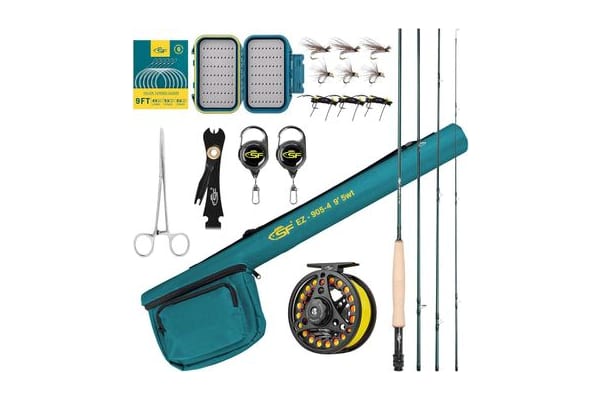 | Complete Starter Kit | SF Complete Fly Fishing Kit | A beginner who wants everything in one box, with light 8ft #3/#4 options for small rivers and 9ft #5/6 and #7/8 for lakes. |
Why the right Fly Rod and Reel combo is important
Once you have mastered the basics of fly fishing and started to settle into a groove then you will be looking to improve – your catch rate, skills, casting, (pretty much everything). This means spending more time at the waterside.
If you are going to enjoy the sport you want to be able to spend more of that time fishing and less nursing sore shoulders or messing about with kit that doesn’t work for you.
The rod needs to be the right length and line weight for your preferred venues of course, and as a general principle, you need a balanced outfit. The fly reel, rod and line must all work in tandem.
Getting the Right Balance
With the classic older style (and usually much heavier) split cane rods, balance was also important but probably more easily achieved because everything weighed more and the set up was less sensitive to reel weight.
With the move to lighter rods – usually carbon fibre, (but there is also a new generation of glass rods) setting up a suitable reel which is not too heavy for the rod will help you to maintain effective casting for a day on the water.
Again modern materials and techniques have come to the rescue with large arbour designs in machined aluminium.
Cast aluminium frames machined down is a cheaper process but heavier than machining from solid aluminium bar stock, and modern resins which create superbly light and strong reels.
You can of course keep fishing all day with a poorly set up rod and reel combination – but your casting efficiency will be impaired and you may well end up flogging the water and scaring the fish with splashy casts.
So, you need the best rod and reel combo set up which enables you to cast about as well at the end of a long day as you were at the start of the day. (And for those of us with bad backs this is even more important).
Getting the balance right also involves checking your own posture, with one foot advanced before the other rather than legs akimbo when casting.
Checkout the following video that emphasises the importance of the correct Fly Rod & Reel balance...
Factors Affecting your Fly Rod and Reel Choice
So; the key factors affecting your choice of rod and reel will be the weight and length of the rod and the range over which you are likely to cast to fish.
An example of this is to consider what size water you are targeting. A setup for reservoir fishing will be different to that if you prefer narrow streams.
Once the water size is decided, a balanced weight of reel which can hold sufficient line of the appropriate weight needs to also be considered.
The rod and line can be matched by the AFTM number – the Association of Fishing Tackle Manufacturers rod and line weight number. The bigger the number the heavier the line which can be thrown further – but requires a more robust and usually much longer rod to flex and cast the line.
If using a heavier setup, you could compensate the extra weight by lightening the load of some other gear. A good fly fishing vest could help with this.
Matching the AFTM numbers is a good guide to setting up the rod for maximum efficiency – the line weight calculation assumes you will have thirty feet (about 10 metres) of line out from the rod top ring in order to load the rod and help it act as a casting ‘spring.’
The best fly rod and reel combo packages will do this for you, so you need some flies and a line and are all ready to go fishing.
The speed of the rod will also be important – whether it has a soft or fast action. There is no point acquiring a super light rod only to find the action is fast and ‘tip action’ with virtually no through-flex.
This is a key consideration If your casting style is relatively soft and slow and you fish small waters with the dry fly and need a gentle action.
High speed rods were all the rage twenty years ago but there seems to be a realisation now that mid action or softer rods are, at least for most of us, much better choices.
If you are a skilled caster, and a dab hand with a fast tip action rod then chances are you don’t need to read this article!
And of course your target species will also have a significant impact on your choice of rod and reel – predator and sea fishing will need a saltwater resistant selection for example.
The Best Fly Rod And Reel Combos
Shakespeare SKP Elite Fly Combo 9ft
#1 Best Overall
If I had to point one person at a single outfit and trust it to cover most of their trout fishing, this is the one I'd hand over. It's a 9ft four-piece carbon rod with a medium-fast action, and 9ft is the length UK stillwater fishing settled on for a reason: enough tip to fish delicately and enough length to mend line and keep a bow off the water.
What makes it an all-rounder rather than a one-water rod is the choice of line weight. The #5/6 suits smaller lakes and the general run of it, while the #7/8 has the extra grunt for a reservoir or a windy day, so it's worth matching the weight to where most of the fishing happens. The graphite Cedar Canyon reel carries a proper disc drag, which is the part I care about when a better fish takes off, and it comes pre-rigged with 75ft of weight-forward floating line over backing.
Because it arrives balanced and loaded, the only jobs left are tying on a leader and picking a fly. That saves the usual beginner headache of guessing which line fits which rod, and it means the rod is casting properly from the first session rather than after a shop trip. Shakespeare even include casting instructions and diagrams in the box, which I think matters more on a fly outfit than any other kind of tackle.
The cork handle and medium-fast blank keep it forgiving without going soft, so it loads nicely at short range and still has something in reserve. It won't feel as crisp as a rod costing several times more, and a committed river angler would want something lighter and shorter. As a do-most-things trout outfit that's ready to fish, though, it's the one I keep coming back to.
Best suited to
All-round stillwater and reservoir trout anglers who want one balanced 9ft outfit that fishes straight out of the box, with the #7/8 covering the bigger waters.
Pros
- Genuinely ready to fish, only add leader and fly
- Proper disc-drag reel, not a basic click check
- Choice of #5/6 or #7/8 covers most trout waters
Cons
- Medium-fast blank is an all-rounder, not a specialist
- Own-brand line is dependable rather than premium
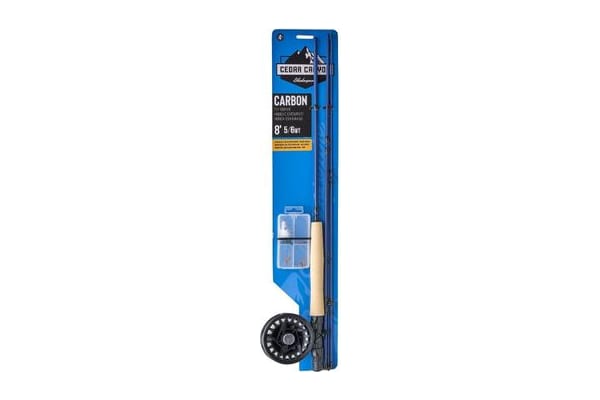
Shakespeare SKP Carbon Fly Combo 8ft
#2 Top for Beginners
Starting fly fishing from nothing is where most people get stuck, and this kit is the one I'd put in a beginner's hands to get past that. It arrives with more in the box than almost anything else here: rod, reel, line, backing, a tapered leader already sorted, a fly selection to get going, and casting instructions to read on the way to the water.
The rod is an 8ft four-piece carbon-composite blank with a forgiving medium-fast action. That forgiveness is the point for a learner, because a softer, more progressive blank flags casting mistakes gently instead of collapsing when the timing's off. The large-arbor Cedar Canyon reel runs a click-check drag rather than a full disc, which is plenty for a starter outfit and keeps the whole thing simple to use.
I like the 8ft length for a first rod more than most would expect. It's easier to control than a 9ft on a tight, tree-lined river or a small commercial, and shorter rods are quicker to load, so early casts come together sooner. The trade-off is reach: on a big open reservoir the extra foot of a 9ft helps punch line into a wind, so this leans towards the smaller, closer waters.
Because the leader and flies are included, this is one of the few kits that genuinely fishes the moment it's unpacked, with no second shopping trip. It's a learner's outfit, so an experienced angler will outgrow the click-check reel and want more line control. As the complete, no-guesswork way in though, it does exactly what a starter kit should.
Best suited to
A first-time fly angler after a genuinely complete kit, with the shorter 8ft length suiting smaller rivers, commercials and tighter banks.
Pros
- Complete kit, includes leader and flies as well as line
- Forgiving 8ft blank suits learning the cast
- Shorter length is manageable on small rivers and commercials
Cons
- Click-check reel is basic next to a disc drag
- 8ft has less reach into wind on big reservoirs
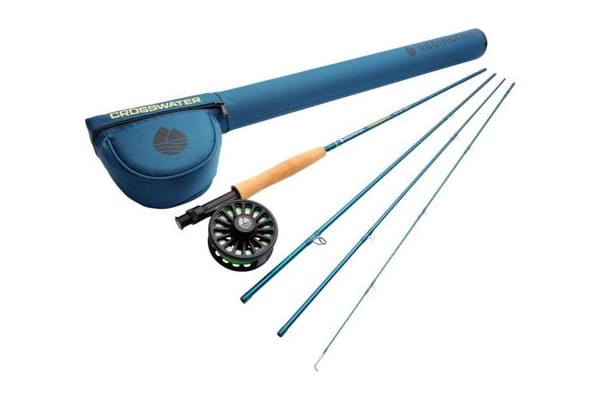
Redington Crosswater Fly Outfit
#3 Premium Pick
Redington is a name that carries weight among fly anglers in a way the general tackle brands don't, and it's the reputation behind this outfit that earns it the premium slot. This isn't a box of parts thrown together to hit a number; it's a matched rod, reel and line put together by people who fish.
The tell is the line. Where the budget kits spool up an own-brand line, this comes pre-loaded with genuine RIO Mainstream WF5F, and a good line does more for how a rod casts than almost anything else in the setup. Pair that with the 9ft four-piece medium-fast graphite blank and the matched Crosswater disc-drag reel, balanced together, and the whole thing simply feels a class above the value kits when it loads and turns a leader over.
The 9ft #5 rating is the reason I'd put it forward as a one-and-only trout rod. A #5 is the weight most river and small-stillwater anglers reach for: light enough to present a dry fly with finesse, but with enough line weight to fish a small lake and cope with a bit of a breeze. It's the classic middle-ground weight, and the zippered travel case means it packs down safely for a session away.
Being honest about who it's for: it sits at the premium end here, so a total beginner unsure whether the sport will stick doesn't need to spend this to learn. Where it makes sense is for the angler who knows they're committed, or who simply wants to start on components they won't be itching to replace within a season. For that buyer, the RIO line and the brand behind it are worth it.
Best suited to
Anglers who want a real step up in components from a respected fly brand, with the 9ft #5 being the definitive do-everything trout weight for rivers and small stillwaters.
Pros
- Genuine RIO Mainstream line, not a no-name spool
- Respected fly brand with matched, balanced components
- 9ft #5 is the versatile do-everything trout weight
Cons
- Premium end, more than a first-timer needs to spend
- Single #5 rating, less suited to windy reservoir work
Hawkridge Colorado Fly Set
#4 For Reservoir Trout
A reservoir bank in a stiff wind is a different job to a sheltered little lake, and this set is built for the harder version. The 9ft 6in length is the traditional reservoir and large-stillwater measure for exactly that reason: the extra half-foot over a standard 9ft helps lift and mend line at range and keeps the backcast up off the water behind.
The #7 rating and fast action are the other half of the story. A fast blank stores more power for the cast, so when the wind's in my face and I need to drive a line out to fish, this has the reserve to do it where a softer medium rod would fold. That same backbone gives it a bit extra in hand for a light sea-trout, which widens where it earns its keep. It's a 24-ton carbon blank with SiC stripper guides and AA-grade cork, so the build is a level above the basic value kits.
It comes matched to a large-arbor #7/8 reel pre-loaded with WF7 floating line, backing and a braided loop for the leader connection, plus a rod travel case. The large arbor is genuinely useful on a reservoir, picking up line quickly when a fish runs at me, and the braided loop saves fiddling with knots to the leader on a cold morning.
Where I'd steer a beginner away is the fast action itself. It's less forgiving of a rushed or mistimed cast than the medium blanks in the Shakespeare kits, so it rewards someone who can already put a line out rather than someone still learning the timing. For an angler fishing big open water who wants power and reach, that stiffness is the point.
Best suited to
Reservoir and large-stillwater anglers fishing bank and boat, where the 9ft 6in #7 length and fast action give the reach and reserve power for wind and light sea-trout.
Pros
- 9ft 6in length gives real reach on open reservoirs
- Fast action punches a line into the wind
- Quality build: 24-ton carbon, SiC guides, AA cork
Cons
- Fast blank is less forgiving for a total beginner
- A #7 outfit is heavier than needed for small waters
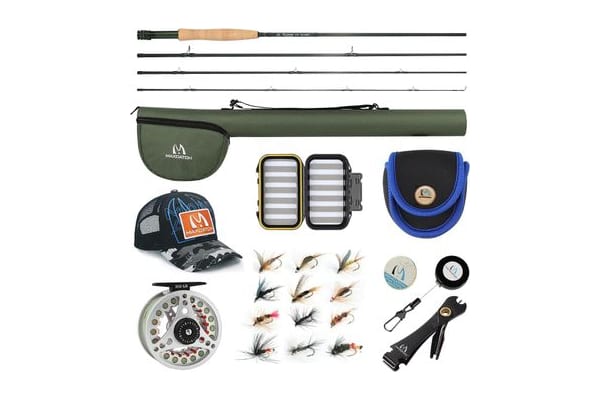
Maxcatch Extreme Fly Combo Kit
#6 best Value
What do I actually need from a cheap first outfit? Something that casts well enough to learn on and doesn't fall apart, without spending real money before I know the sport suits me. That's the brief the Maxcatch Extreme is built to answer, and it's why it takes the value slot.
The clever part is the line-weight range. It's offered anywhere from a light #3 for a small river up to a #8 for reservoir and predator work, so instead of a one-size compromise I can match the outfit to my actual water before it even ships. That flexibility is rare at this money and makes it as sensible for a stream dry-fly setup as for a stillwater lure rig.
The kit itself is a four-piece graphite rod, a pre-spooled large-arbor reel already carrying a weight-forward line over backing, and a rod tube to travel with. Maxcatch have a solid reputation among budget fly gear and this outfit is well reviewed, which is the reassurance I want before recommending anything at the bottom of the price range.
The honest caveat is that it's a value outfit, so the components are dependable rather than refined, and the line is a decent own-brand rather than a premium one. It's also more of a self-assembly starting point than a hand-holding kit. As a first setup to learn on, or a cheap spare to keep made up for a different line weight, it's hard to argue with.
Best suited to
Buyers after the most rod for the least outlay, or a spare, with a line-weight choice from #3 for small rivers up to #8 for reservoirs and predators.
Pros
- Line weight selectable from #3 to #8 to match the water
- Well-reviewed budget outfit from a known value brand
- Cheap enough to justify as a first setup or a spare
Cons
- Components are dependable rather than refined
- Own-brand line, and more self-assembly than hand-holding
SF Complete Fly Fishing Kit
#6 Complete Starter Kit
Open the box on this one and there's very little left to buy, which is the whole appeal. Alongside the 24-ton carbon rod and a pre-spooled reel it packs a carry case, a fly box with flies already in it, and a tapered leader, so it covers the odds and ends that catch a first-timer out.
The bit that lifts it above a bare rod-and-reel combo is that fly box. A beginner rarely knows which flies to start with, and having a selection ready to tie on removes one more barrier between unpacking the kit and actually fishing. The tapered leader in the box does the same job at the business end, so nothing's missing on the first trip.
Line-weight choice keeps it flexible. The light 8ft #3/#4 option is a genuine small-stream setup, delicate enough to enjoy fishing a little river, while the 9ft #5/6 and #7/8 builds suit lakes and the bigger stillwaters. That spread means the same kit can be pointed at very different water depending on which version I pick, so it's worth choosing the weight around the intended venue.
The trade-off is the one every budget kit carries: the components are made to a price, so the flies and line are there to get started rather than to impress, and the outfit needs a check-over and a bit of self-assembly out of the box. As the most complete way to hand someone everything they need to try fly fishing in a single purchase, though, it's the kit I'd point a total newcomer at.
Best suited to
A beginner who wants everything in one box, with light 8ft #3/#4 options for small rivers and 9ft #5/6 and #7/8 for lakes.
Pros
- Most complete kit here, includes a fly box with flies
- Tapered leader supplied, ready to fish on day one
- Light 8ft #3/#4 option makes it a genuine stream choice
Cons
- Budget components, made to a price to start on
- Needs checking over and some self-assembly out of the box
Fly Combo FAQs
Still choosing a first fly outfit?
These are the questions worth settling before buying.
Is a fly rod and reel combo good for beginners?
Yes, a combo is one of the best ways to start fly fishing. The rod, reel and line are already matched and balanced, and most kits come pre-loaded with backing and a weight-forward floating line, so there is no guesswork over what fits what. You save money over buying separately and often only need to add a leader and a few flies to fish.
What weight fly rod should a beginner choose?
For UK stillwater and reservoir trout a 9ft #7 or #7/8 is the classic all-round choice, with enough backbone to punch a line out in wind. For smaller rivers and streams a lighter 8ft to 9ft #5 is more delicate and fun. If you only buy one, a 9ft #7 covers the most water.
What comes in a fly fishing combo kit?
At minimum a matched fly rod and reel, usually with the reel pre-loaded with backing and a weight-forward floating fly line. Better kits add a tapered leader, a rod tube or travel case, and sometimes a small fly selection and casting instructions, which makes them genuinely ready to fish out of the box.
Do I need an expensive fly combo to start?
No. A sensible mid-price outfit like the Shakespeare SKP casts well and lasts, and is plenty to learn on. Spend more only if you want a premium blank and a genuine branded line, such as the Redington Crosswater with its RIO line. A cheaper complete kit is a fine way to try the sport before committing.
Summary & Conclusions
So there you have it; a range of the best fly rod and reel combo deals for a range of fishing applications from lake and Stillwater fishing, to river and long rod Czech nymphing styles.
There have never been such consistently good rods and reels available for the money.
As always with game fishing, please familiarise yourself with the local catch and keep rules for your region if your goal is such.
Related Articles...

Best Polarised Sunglasses For Fishing
Polarised glasses are more than just looking ‘cool’. They are a vital tool that can give you the edge when fishing. So what are the best polarised sunglasses for fishing? Well, read on to find out!
Best Fishing Waders
In this article, we will take you through the different types of fishing waders in the UK and provide some insight on what goes into the best fishing waders on the market today.
Catch and Keep Fishing in the UK
In this article we are going to discuss all things surrounding catch and keep fishing and hopefully give you a better understanding on what you should or should not do.